
Experiment: Roller Rebound
A roller-skating sport built around movement, rebounds and an interactive arena
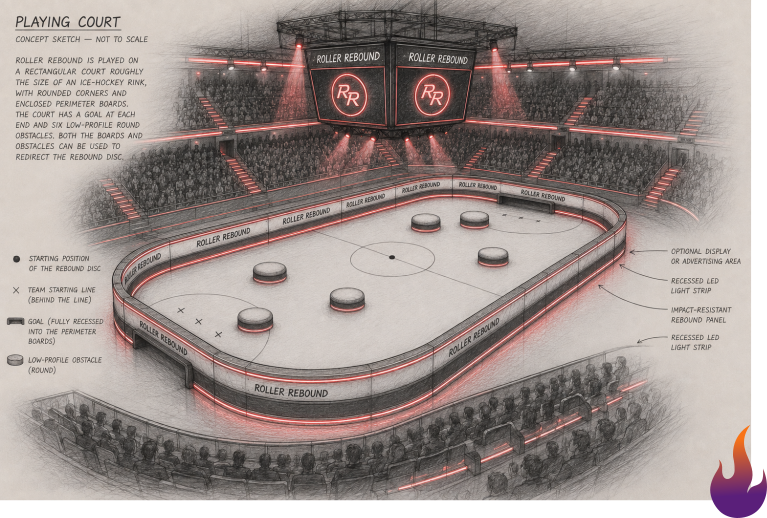
Roller Rebound is a speculative creative exercise: an attempt to imagine what a roller-skating spectator sport could look and feel like. It is not a proposal for a finished or validated sport.
The concept combines roller skating, rebound play and gaming-inspired presentation in a fast 3v3 format. Rather than treating the court as a simple boundary, Roller Rebound imagines an arena in which boards and obstacles actively shape the game.
It began with a question:
What could a new spectator sport look like if roller skating, rebound play and gaming-inspired presentation were combined?
Imagine the match
The arena lights dim as six skaters line up near their own goals. At the center of the court rests the Rebound Disc.
When the starting signal sounds, both teams accelerate towards it. This opening moment is called the Rush. There are no dedicated goalkeepers and no fixed attacking position. From the first seconds, every player needs to balance moving forward to attack the opponents goal with protecting their own.
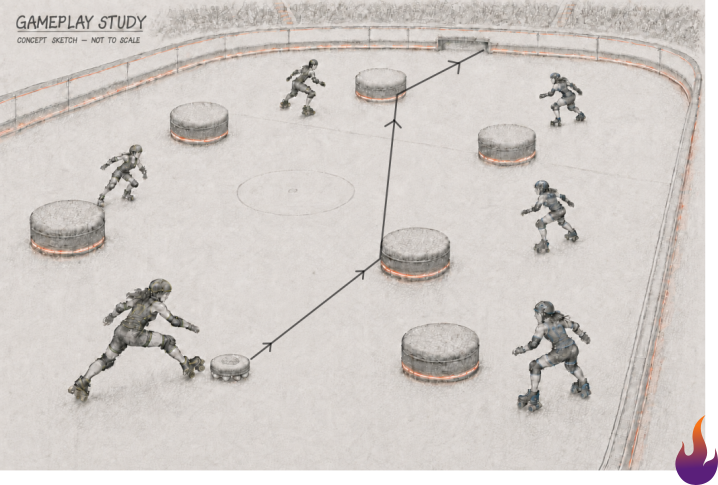
One team gains control of the disc, but the direct route across the court is blocked by an opponent. Instead of stopping, the player redirects the disc towards the perimeter. It rebounds behind the defender and changes the angle of the attack. Another skater anticipates its path and redirects it around one of the circular obstacles. The obstacle blocks the route and creates a new opportunity for the opposing team to intercept. In Roller Rebound, the court does not simply contain the game. It becomes part of how the game is played.
The disc approaches the goal and crosses the line. The arena briefly changes to the scoring team’s color. Lights, screens and the scoreboard respond immediately, making the moment visible throughout the space. Play restarts with another Rush.
As the final five minutes of the round begin, the arena lighting changes to red. During the last minute, the lights begin to pulse to create a sense of urgency. The players still need to watch the clock, but the remaining time can also be felt around them.
That is the experience Roller Rebound is intended to explore: continuous movement, changing angles and a playing environment that responds to the action.
The concept at a glance
Two teams compete with three skaters on the court.
There is no dedicated goalkeeper.
Players control and redirect the Rebound Disc using their roller skates.
The perimeter boards and circular obstacles can be used to create rebounds, passes and unexpected attacking angles.
A goal is scored when the disc completely enters the opposing goal.
Lighting and screens provide visual feedback during important moments.
The basic objective remains familiar: score more goals than the opposing team.
Making roller skates part of the game
Roller skating is not intended as a visual novelty added to an existing sport. It shapes how players move and how they interact with the disc. Players would need to maintain speed and balance while controlling a disc shaped object at approximately foot height. Because there is no dedicated goalkeeper, all three skaters would continuously move between attacking and defending.
The small team format is intended to keep every player involved. It could also make changes in position and momentum easier for spectators to follow. The goal-based objective is deliberately simple. The additional complexity would come from the movement of the skaters, the behavior of the disc and the different routes created by the playing environment.
When the court joins the game
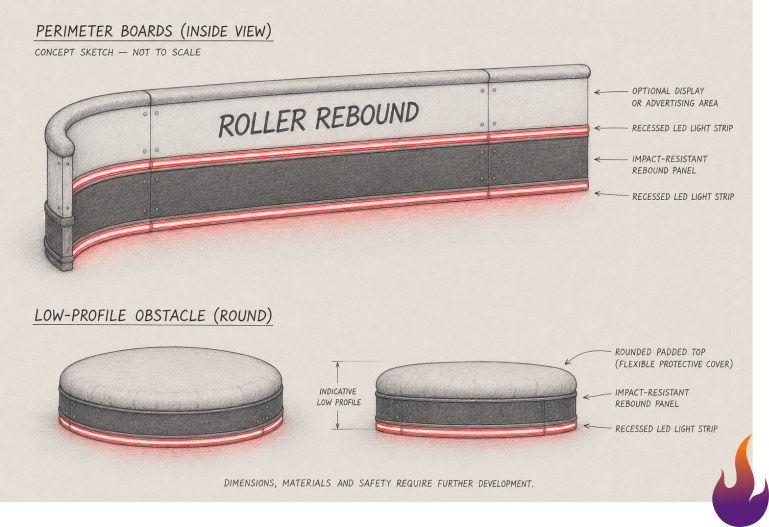
Roller Rebound is imagined on a rectangular court approximately the size of an ice-hockey rink, with rounded corners, an enclosed perimeter and one low, wide goal at each end. Circular obstacles would be positioned across the playing surface. Their role would not only be to interrupt direct routes. Like the outer boards, they could redirect the Rebound Disc.
A player might use the perimeter to pass around an opponent, approach the goal indirectly or send the disc towards a teammate from an unexpected direction. The obstacles could create similar possibilities within the court. This is one of the central ideas behind Roller Rebound. The environment influences the game rather than simply surround it.
The exact number, size and position of the obstacles have deliberately not been fixed. They would need to create tactical possibilities without unnecessarily restricting movement or introducing unacceptable collision risks.
The Rebound Disc
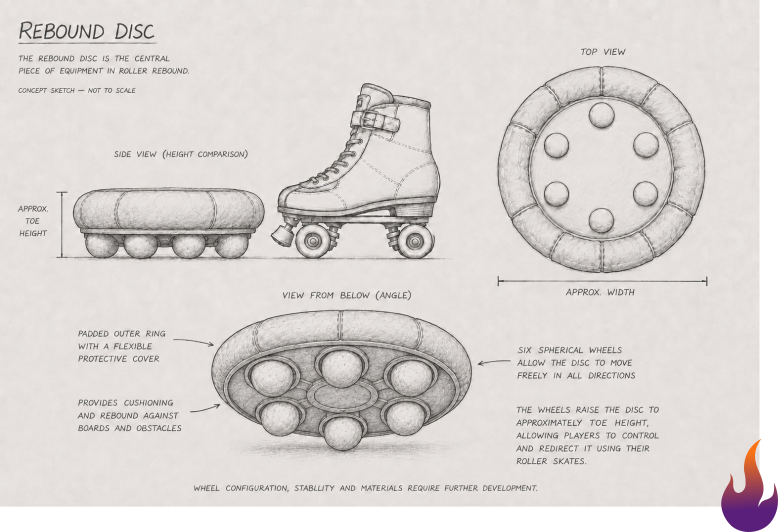
The Rebound Disc is imagined as an object roughly the length of a roller skate and slightly higher than toe level. Its base would use several spherical wheels, allowing it to move freely in different directions. A padded inflatable ring around the outside could help protect players while also supporting rebounds from the boards and obstacles. Players would not use sticks or control the disc with their hands. Their roller skates would be the main point of interaction.
The present design is only conceptual. Its dimensions, weight, stability, wheel mechanism and safety would all require physical development and testing. The important idea at this stage is not the exact construction, but the type of movement it might make possible.
A sport designed to be watched
Roller Rebound is imagined as both a physical game and a spectator experience. The arena would use lighting, color and screens to make important moments immediately visible. A goal could briefly transform the space into the scoring team’s color. Changes in lighting could communicate the closing minutes of a round and increase the sense of urgency.
This draws inspiration from games and arcade experiences, where visual and audio feedback communicate progress, time and reward. The intention would not be to overwhelm the game with effects. The presentation should help spectators understand and feel what is happening. The timing, intensity and usefulness of these effects would therefore need to be explored with players, live spectators and broadcast viewers.
One possible match format
A match could consist of a maximum of five fifteen-minute rounds. The team scoring the most goals would win the round, and the team winning the most rounds would win the match. If both teams had won the same number of rounds after the fifth round, the match could continue into sudden death, with the next goal deciding the winner.
Teams might have a larger squad available during matches and tournaments, while selecting three active skaters for each round. This could allow different player combinations and strategies without interrupting the continuous movement within a round.
This is only one possible format. It was developed to imagine how momentum, tactical changes and a clear match structure might work. It has not been tested for pacing, physical demand or spectator engagement.
Why these choices came together
Several design intentions shaped the concept:
Keep the main objective easy to understand.
Make roller skates essential to the gameplay.
Give every player both attacking and defensive responsibility.
Create indirect routes and unexpected angles.
Let the arena contribute to the action.
Use visual feedback to communicate important moments.
Not every idea survived the development process. An earlier version used a bowl-shaped court inspired by skating environments. Although I liked its visual character, it created practical and viewing problems.
I decided to let go of the bowl, but retained the principle that made it interesting, the playing surface should affect the movement of the disc. That idea continued through the perimeter boards and circular obstacles.
What remains uncertain
Roller Rebound currently exists as an imagined experience, not as a functioning sport.
Important questions remain:
Could the Rebound Disc be controlled safely and consistently using roller skates?
What dimensions and wheel configuration would make its movement stable but responsive?
Would the obstacles create tactical depth or mainly increase collision risks?
Which court dimensions and obstacle placements would produce an understandable flow?
Would the match format be physically realistic and engaging to watch?
Would the intended audience find the sport appealing?
Would the lighting effects improve understanding and atmosphere without becoming distracting?
If the idea were developed further, the next step should not be adding more rules. It would be exploring whether the basic interaction between skaters, disc, boards and obstacles could produce safe, understandable and enjoyable gameplay.
Development status
Roller Rebound is an early-stage speculative concept and personal creative experiment. Its gameplay, safety, technical feasibility and audience appeal have not been validated. Its purpose is to explore how a passing observation can grow into a more coherent imagined experience and to make that thinking visible.
Curious how this idea developed from sticky notes to this concept? Read about the creative process behind Roller Rebound →