
How a personal experiment with Action filled my head with ideas instead
When I started exploring design thinking, I was not sure what to make of it. I wanted to become better at releasing my wilder, bigger ideas. Free association first, unexpected connections next, and only then shaping those thoughts into hypothetical concepts. Design thinking, with its steps, frameworks and user evidence, seemed more likely to restrict my creativity than strengthen it.
That doubt became the experiment. I did not have to accept the method in advance, I could test it.
Why Action?
I chose Action because it is a familiar Dutch retail concept. Straightforward, price-led and built around a constantly changing assortment. I enjoy shopping there, but while individual products can activate new ideas, same as materials in DIY stores, the store concept itself did not immediately inspire me. That made Action an ideal test subject. I gave myself a simple assignment, investigate the barriers customers experience and design a possible solution. The subject became a puzzle, and puzzles make things interesting for me.
This is an independent personal learning experiment, not commissioned by, affiliated with or developed in collaboration with Action.
Listening without solving
I interviewed five friends and neighbors. This was not a representative sample, nor was it intended to be. My goal was to practice the method and discover what patterns, tensions and questions could emerge from real stories.
After the interviews, I created action cards that separated situations and concrete behavior from possible meanings and remaining uncertainties. I also distinguished between specific reported visits, general self-reporting, perceptions and possible design criteria. This was the most difficult and time-consuming step. My wording kept blurring the categories: actions became conclusions, opinions started to resemble evidence and interpretations sounded more certain than the interviews justified. I repeatedly had to ask: did the participant actually do this, did they describe it in general terms, or was it my interpretation?
That difficulty was also where the real learning began. The cards slowed down my problem-solving reflex and exposed the connections I was filling in myself.
From observations to design tensions
I printed and clustered the cards around five themes: Action’s role within a wider shopping trip, price and perceived value, changing purchase behavior, messiness, and the changing assortment.
I had intended to find and solve a problem. Instead, the clusters showed that a problem is not automatically the most interesting opportunity. Messiness affected perception, but some participants accepted it as part of a low-price format or even associated it with discovery. My small study gave me little reason to expect that a tidier store would automatically generate more purchases.
A different pattern offered more room. Participants often combined Action with supermarkets, drugstores, DIY stores or other retailers. Planned visits also activated forgotten needs and future plans. The opportunity became: help customers recognize and fulfill more relevant needs during one visit, without sacrificing low prices, simplicity or discovery.
Then the tap opened
Once the challenge became clearer, my creativity took off. I wrote down twenty ideas, including temporary Action-themed retail events, large-scale brand purchases, an XL store, locally adapted assortments, color-coded departments, a monthly featured category and new ways of presenting seasonal products.
My mind immediately added disadvantages, implementation questions and possible effects. One night I switched on the light several times to write things down. It was tiring but revealing, a subject that had initially failed to inspire me had produced an entire concept store in my head.
From twenty ideas to one testable island
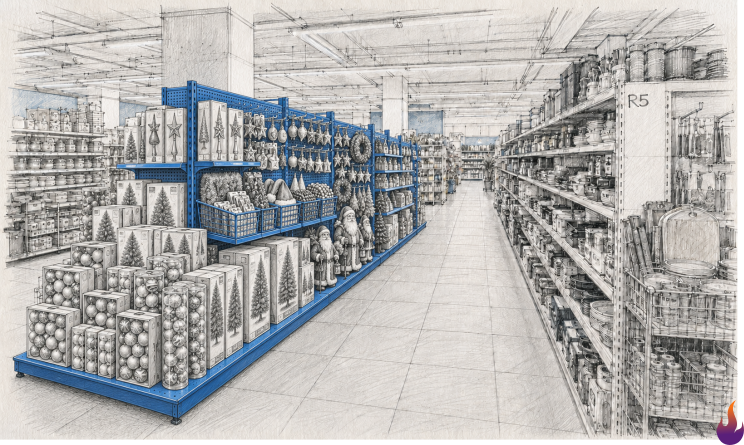
I selected one testable idea: a flexible blue-metal island for seasonal goods. I wanted to learn whether it would attract more attention than conventional shelving and whether its position might also expose customers to adjacent categories leading to additional sales.
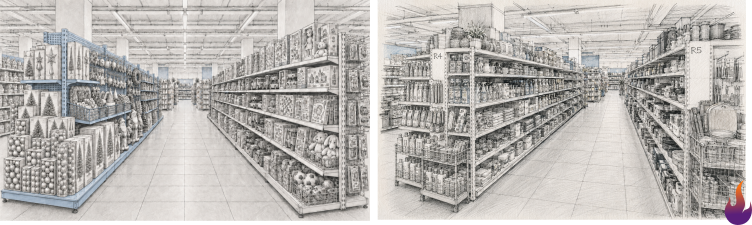
While developing floor plans and perspective sketches, I noticed a risk: color and perspective could direct attention towards the island. I might be testing the illustration rather than the layout. I therefore created a more neutral aisle view with both sides equally visible and only a restrained blue accent.
What the small test did, and did not tell me
The island attracted everyone’s attention. Participants quickly noticed the different color and felt that it added atmosphere to Action’s predominantly white fixtures. People with children tended to notice the toys sooner than those without children.
This provided preliminary support for the first hypothesis, but the test involved a small group of people I knew, viewing drawings rather than experiencing a real store. It therefore said nothing about actual purchasing behavior. The second hypothesis remained unresolved because toys were not a neutral comparison category. A follow-up could use several categories and concrete search tasks. That was not a failed test, but a limitation that gave the next iteration direction.
What I learned about design thinking
The action cards changed my thinking most. They taught me to separate concrete behavior and self-reporting from interpretation and assumptions that still required testing. By gaining a clearer picture of what I wanted to influence, and which qualities of the existing concept I should preserve, I found more creative room.
I had deliberately chosen a detailed process to understand the method. Next time I could cluster sooner, prototype earlier and learn through iteration. The discipline lies not in producing as many documents as possible, but in separating what I observed, what I think it means and what I decide to test.
The concept is not proven, and it did not need to be. The more personal result is that structure and wild ideas do not have to be opposites. A useful constraint can trigger creativity, even when the subject initially offers little inspiration.
Want to see where the other ideas ended up?
Step inside the imagined Mega Action and explore the complete concept in the linked Idea Vault article →