
Mega Action: A Location-Based Retail Concept
How Twenty Separate Ideas Became One Store
This is an independent personal concept created during a design thinking experiment. It was not commissioned by, affiliated with, or developed in collaboration with Action. The concept as a whole has not been researched or validated.
My design thinking experiment about Action generated twenty ideas. Some were small and practical; others quickly expanded into complete retail concepts. Not every idea was strong enough to stand on its own. Some would have been too complex to implement, while others still depended heavily on untested assumptions. Yet several contained an element worth keeping.
Within the design thinking process, I used convergent thinking to compare the ideas against the research, design criteria, expected impact, and feasibility. I selected one flexible seasonal island to develop into a prototype and test. That focused process, and what I learned from it, is described in the linked blog article
Mega Action emerged afterward, when I returned to the ideas that had not been selected for the experiment. Rather than treating them as discarded, I explored whether their strongest elements could contribute to a broader creative concept. A temporary retail event contributed to abundance and a specific reason to visit. An XL store provided room for new categories but gained purpose only when connected to its location. The seasonal presentation developed into a flexible, year-round platform. Gradually, the separate ideas began to form one imagined store: Mega Action.
This wider concept is primarily a product of creative thinking. The interviews and small visual test provided some direction, but they do not demonstrate that the complete store would work commercially. For the Idea Vault, however, uncertainty does not have to be the end of an idea. It can be the beginning of a concept worth exploring.
A Visit to Mega Action
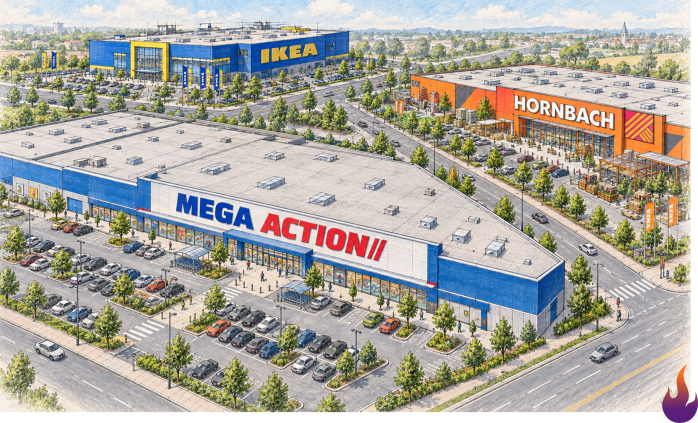
Mega Action is located in a retail complex beside IKEA and a home improvement store such as Hornbach. The location is part of the idea. Visitors are already furnishing a home, completing a repair, or carrying out an existing plan. Mega Action does not attempt to fully copy its neighbors. Instead, it adds lower-priced alternatives, temporary finds, and complementary product categories to the same shopping trip.
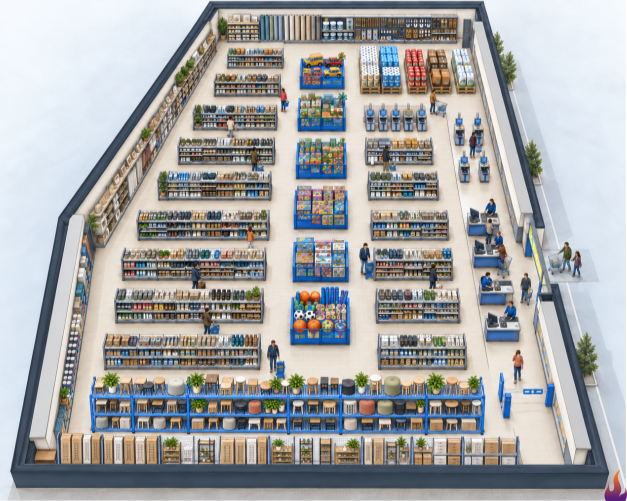
You enter from the side of the building and follow the route alongside the staffed and self-service checkouts toward the lower end of the store. The entrance gates are located near a large small-furniture island.
This is not a conventional Action aisle. It is a multilevel blue-metal system displaying stools, side tables, and ottomans. Customers can walk around the entire presentation and view the products from different sides.
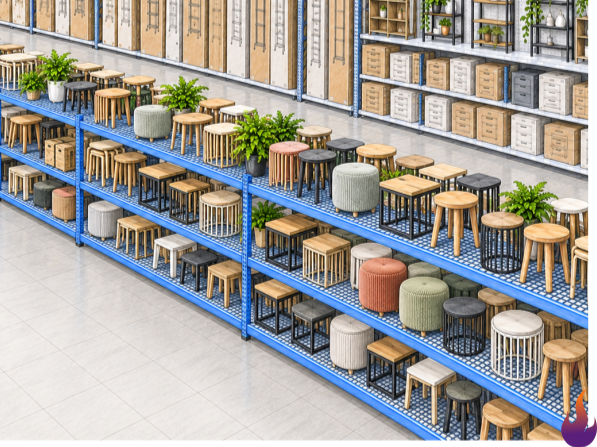
A long flat-pack wall forms the backdrop. Tall boxes contain decorative shelving units, while smaller packages hold drawer units, side tables, and other compact furniture. This is not intended to be a permanent, coordinated collection. It can consist of changing batches and temporary styles, as long as the prices remain clearly below those of comparable products nearby and the perceived value remains credible.
From here, the route continues through an expanded home and DIY assortment. The wall opposite the entrance displays ready-made curtains, wallpaper, window film, wall paint, and decorating tools. Nearby shelves add an extra-large assortment of home decor, storage solutions, and practical household products.
In the angled section of the building, five shelving runs become progressively shorter. Beside them is an open pallet zone containing bulk presentations of toilet paper, paper towels, canned beverages, coffee, and laundry detergent. Food and snacks continue nearby. The presentation is deliberately simple: value should be immediately visible.
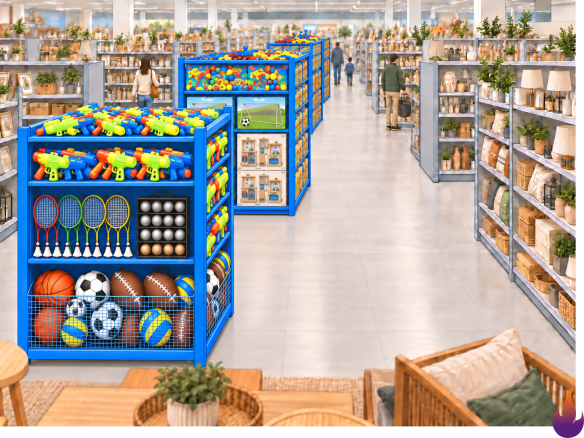
The route then reaches a central aisle. Five wide, tall, double-sided blue-metal islands stand between two banks of regular shelving. Perforated back panels, shelves, baskets, hooks, and open platforms make the system adaptable. The islands are intended to carry seasonal products. Between seasons, they become a stage for a temporarily expanded product category.
In this version, the featured category is toys. The first island combines baskets of sports balls with badminton sets, boules sets, and water pistols. Another holds large flat packs containing play kitchens and soccer goals. The remaining islands carry puzzles, board games, craft sets, vehicles, construction toys, and outdoor play equipment.
The expanded assortment is featured in Action’s promotional materials and on social media, not as a sale, but as a temporary expansion of the category.
Regular product categories remain visible on both sides of the central aisle. The islands may capture attention, while the regular categories opposite them create opportunities for reminder and complementary purchases.
The Ideas Inside the Concept
Mega Action combines four families of ideas. In each case, the reason an earlier version was rejected also influenced how the idea was eventually applied.
1. Location and Assortment
Connected ideas: An XL branch, an assortment that responds to neighboring retailers, more small furniture near a home-furnishing destination, and a larger children’s assortment in residential areas.
Application: Located beside IKEA and Hornbach, Mega Action allocates more space to small furniture, home décor, and DIY products. A branch in another location could receive a different expansion. The surrounding stores become part of the assortment strategy and provide a possible reason to visit this particular location.
Why the initial idea changed: A larger Action containing more of the same would mainly add floor space and inventory, not meaning. The XL idea therefore became location-based: expand only where the additional categories connect logically to the shopping trips customers are already making.
2. Temporarily Expanded Categories
Connected ideas: A temporary Action-themed retail event, large-scale temporary brand purchases, a monthly featured category, and a weekly circular or social media feature for additional inventory that does not need to be discounted.
Application: The five seasonal islands form a flexible, year-round retail platform. They carry seasonal merchandise during peak periods and temporarily expanded assortments of toys, hobby supplies, storage products, or selected branded goods between seasons.
Why the initial idea changed: A separate themed event in an exhibition hall would require another location, additional logistics and staffing, and enough visitors within a limited period. Its commercial return would be uncertain. The attractive elements, greater choice, temporary availability, and a specific reason to visit, were therefore moved into the central islands.
3. Product Presentation and Shopping Behavior
Connected ideas: Dividing product categories across multiple aisles, creating central buying islands, making seasonal products more noticeable, and increasing exposure to adjacent categories.
Application: The blue-metal islands interrupt the rhythm of the conventional white shelving and create a recognizable destination within the store. Their modular design can accommodate small hanging products, baskets of loose merchandise, boxed goods, and larger products displayed on open platforms.
Because each island connects two regular aisles, customers approaching the featured category are also exposed to the product categories around it. This may activate a forgotten need, a future plan, or a complementary purchase.
Why the initial idea changed: Dividing every product category across multiple aisles could make the store harder to understand and reduce the simplicity of the existing format. The idea was therefore limited to five flexible islands. This creates variation without reorganizing the entire store.
4. Price, Trust, and Recognizable Value
Connected ideas: Larger temporary purchases from known brands, deeper assortments within selected categories, and using familiar products to attract customers who are more cautious about quality.
Application: A temporary expanded category could include a broader selection from a recognizable brand, provided that the price difference remains meaningful. These products could act as a reason to visit while customers continue to encounter Action’s regular and less familiar brands.
Why the initial idea changed: Simply adding more branded products could weaken the low-price model or make Action resemble other retailers. In Mega Action, branded purchases remain temporary and selective. They support a featured category rather than becoming the foundation of the store.
Curious how this concept emerged?
Read the linked personal blog article → about my design thinking experiment: the difficult action cards, the moment the problem became an opportunity, and the night the ideas refused to stop.