
Concept: Roller Rebound
A roller-skating sport built around unpredictable rebounds
Roller Rebound is an early-stage concept for a 3v3 roller-skating sport built around speed, movement and unpredictable rebounds.
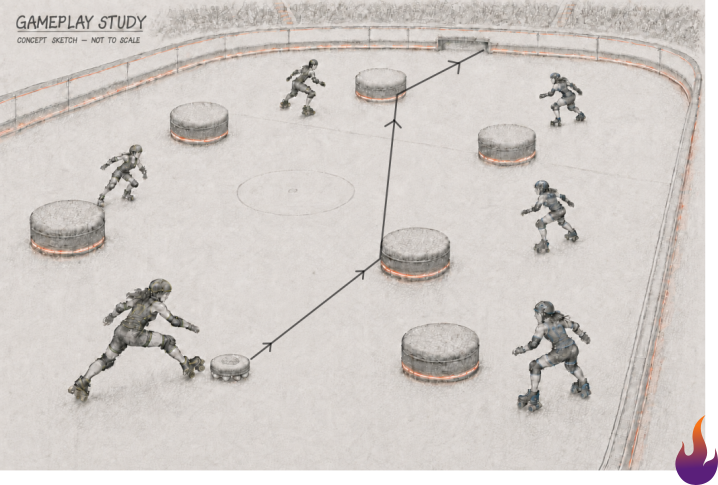
Two teams compete on a closed court using a specially designed Rebound Disc. Players can only control and redirect the disc with their roller skates. The perimeter boards and circular obstacles are not merely boundaries: they can be used to change the direction of the disc, create new angles and set up attacks.
The sport is designed with spectators in mind. Lighting, screens and immediate visual feedback help communicate important moments during the match, drawing inspiration from gaming, arcade experiences and action-sport events.
Roller Rebound explores a simple question:
What could a new spectator sport look like if roller skating, rebound play and gaming-inspired presentation were combined?
The concept at a glance:
Two teams compete in a three-versus-three format.
Players attack and defend without a dedicated goalkeeper.
The Rebound Disc can only be played using roller skates.
Perimeter boards and circular obstacles can be used to redirect the disc.
A goal is scored when the disc completely enters the opposing goal.
Matches consist of a maximum of five fifteen-minute rounds.
Lighting provides visual feedback after goals and during the closing minutes.
Teams collect points through tournaments held throughout the season.
What makes Roller Rebound different?
Roller skating is not simply a novelty added to an existing sport. Its movement possibilities directly shape how the game is played.
Players must maintain speed and balance while using their skates to control and redirect the Rebound Disc. With no dedicated goalkeeper, all three skaters continuously switch between attacking and defending. The perimeter boards and obstacles are active elements of play, enabling indirect passes, unexpected angles and rebound-based attacks.
Roller Rebound combines a simple goal-based objective with an interactive playing environment that adds tactical complexity while keeping the basic game easy to understand.
The game
1. Objective and scoring
The objective is simple: score more goals than the opposing team.
Each team defends one goal and attacks the goal at the opposite end of the court. A goal is scored when the Rebound Disc completely enters the opposing goal. Every goal has the same value. The complexity is intended to come from the movement of the skaters, the behavior of the disc and the use of the playing environment rather than from a complicated scoring system.
Keeping the objective familiar should make the basic game easy for new spectators to understand.
2. Match format
A match consists of a maximum of five rounds. Each round lasts fifteen minutes, and the team that scores the most goals wins that round.
If both teams have scored the same number of goals when the time expires, the round ends in a draw and neither team receives a round win. The match can end early if one team has secured a lead that the opposing team can no longer equal in the remaining rounds. Otherwise, all five rounds are played. After the fifth round, the team with the most won rounds wins the match. If both teams have won the same number of rounds, the match continues into sudden death. The first team to score wins.
Dividing the match into rounds creates several opportunities for momentum to change. It also allows teams to adjust their line-up and strategy during the match.
3. The Rush
Every round begins with a Rush. The same procedure is used to restart play after a goal.
The Rebound Disc is placed at the centre of the court. Both teams line up near their own goal, behind their starting line. At the starting signal, all six players are released and can race towards the disc to gain possession.
The Rush is intended to provide a clear and energetic restart while immediately creating competition for control of the disc.
4. Team composition
A Roller Rebound team can have a squad of up to nine skaters.
For each match, the team selects six players from its squad. Three players are on the court at any one time, with the remaining three available for later rounds. There is no dedicated goalkeeper. Every player must contribute to both attack and defence, requiring teams to continuously balance forward movement with protection of their own goal. Teams may change their three active players between rounds. Substitutions are optional, allowing a team to retain a successful line-up or introduce a different combination of skaters.
The larger squad becomes particularly relevant during tournaments, when teams may need to play multiple matches on the same day.
The equipment and environment
5. Playing court
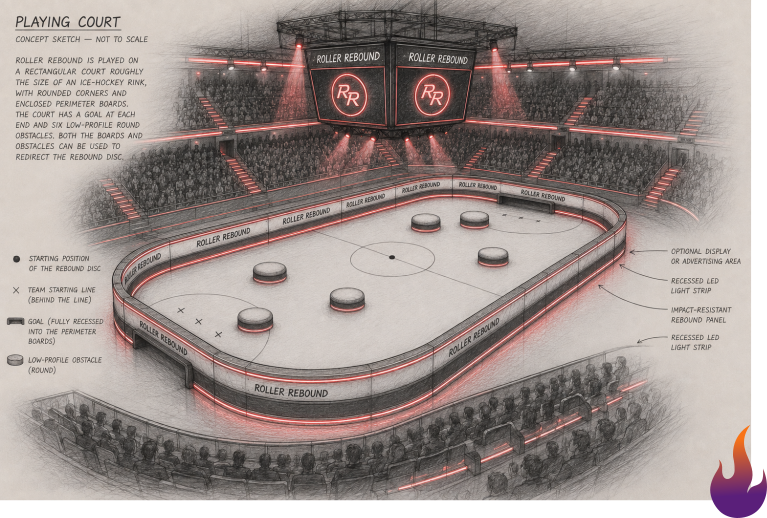
Roller Rebound is played on a rectangular court approximately the size of an ice-hockey rink. The court has rounded corners, enclosed perimeter and one low, wide goal at each end. Circular obstacles are positioned across the playing surface. Both the obstacles and the outer perimeter boards can redirect the Rebound Disc. This allows players to use the environment deliberately. They might rebound the disc around an opponent, create an indirect pass or approach the goal from an unexpected angle.
The obstacles also interrupt direct routes across the court. This is intended to support the three-versus-three format by discouraging repeated long-range shots and creating different paths through the playing area. Their exact number, size and placement would need to be tested. They should introduce tactical possibilities without unnecessarily restricting movement or creating unacceptable collision risks.
6. Rebound Disc
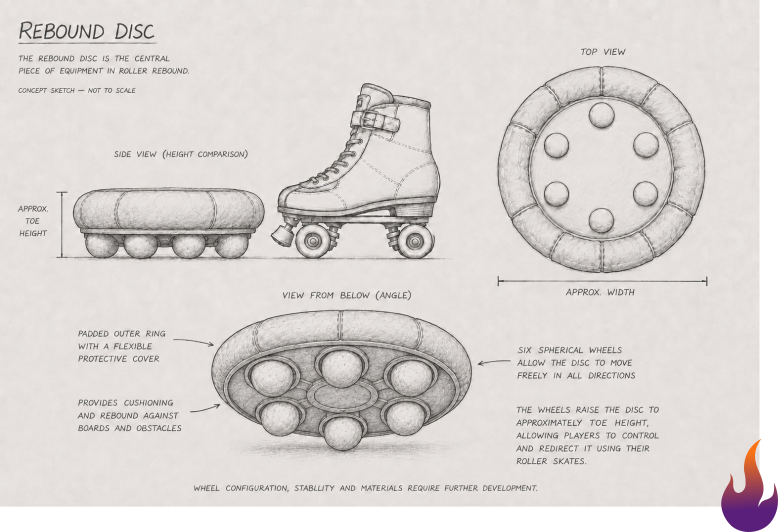
The Rebound Disc is the central piece of equipment used in Roller Rebound.
The disc is roughly the length of a roller skate and rises slightly above toe height and supported by six large spherical wheels. These wheels are intended to allow the disc to move freely in different directions while raising it to approximately foot height.
Players control and redirect the disc using their roller skates. They do not use sticks or handle it with their hands. An inflatable padded outer ring protects the players and helps the disc rebound from the boards and obstacles. The combination of free movement and a playable perimeter is intended to make changes of direction central to the gameplay.
The current design is conceptual. Its dimensions, weight, wheel mechanism, stability and safety would require technical development and physical testing.
7. Outer boards and obstacles
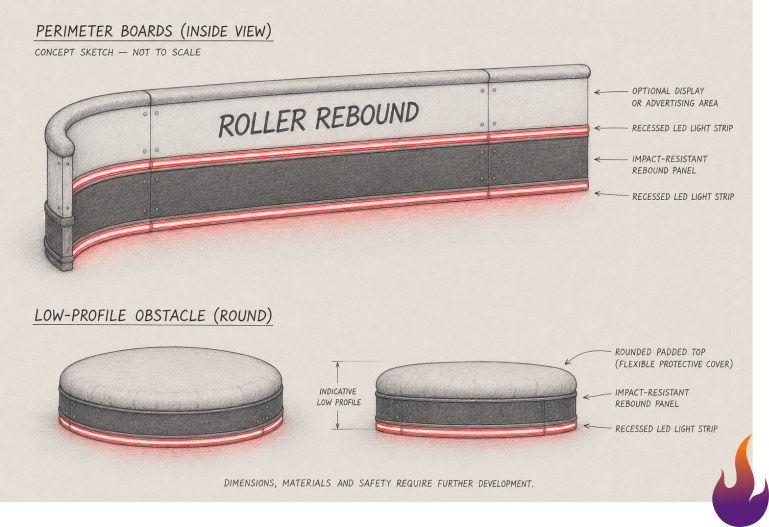
The outer perimeter contains a hard surface positioned at the approximate height of the Rebound Disc. This surface is intended to return the disc to the playing area cleanly and consistently. Recessed LED strips run above and below the rebound surface. The upper section of the boards can be used for team identity, event information or advertising.
The circular obstacles use a similar rebound surface and include a rounded, padded top. Their construction is intended to reduce sharp edges and provide some protection during contact, although their safety would still need to be evaluated in practice.
Together, the boards and obstacles create the central characteristic of the sport: the court does not simply contain the game but actively influences it.
Spectator experience
8. Atmosphere and visual feedback
Roller Rebound is designed as both a physical competition and a viewer experience.
Lighting effects provide immediate feedback during important moments. When a team scores, the lights, viewing screens and scoreboard can briefly display that team’s color, creating a visible celebration throughout the arena.
At the ten-minute mark of each round, the lighting around the court and above the audience changes to red. This signals that the final five minutes have begun. During the final minute, the lights begin to pulse, making the remaining time immediately visible and increasing the sense of urgency.
The system is inspired by games and arcade experiences, where changes in color, sound and light communicate progress and reward. In Roller Rebound, these effects are intended to support the game rather than distract from it.
The timing and intensity of the effects would need to be tested with players, live spectators and broadcast viewers.
Competition structure
9. League format
The Roller Rebound league is structured around a series of tournaments held throughout a season.
Teams receive league points based on their finishing position in each tournament. These points contribute to an overall leaderboard. At the end of the regular season, the four highest-ranked teams qualify for the playoffs. The remaining teams are eliminated, while the qualified teams compete to determine the league champion.
A tournament-based format could allow the sport to be presented as a series of individual events while still building a continuing season narrative.
The exact number of teams, tournaments and ranking points has deliberately been left open at this stage.
Development status
Roller Rebound is an early-stage concept, not a finished sporting proposition or technical design. Its gameplay, safety, audience appeal and technical feasibility have not been validated. The current rules, dimensions and equipment designs should be understood as working assumptions.
Key questions for future development
Can the Rebound Disc be controlled safely and consistently using roller skates?
What dimensions and wheel configuration would give the disc stable but responsive movement?
Do the obstacles add tactical depth without creating unacceptable collision risks?
What court size and obstacle placement would produce the best flow?
Is the five-round match format engaging and easy to follow?
Do the lighting effects improve the viewing experience without distracting from the game?
Curious how the concept was developed? Read about the creative process behind Roller Rebound →