
Just Dabbling with a New Roller-Skating Sport
While cycling home after doing some grocery shopping, I passed a couple of girls on roller skates. It made me wonder: why do I rarely see roller-skating sports on television?
I rarely watch television and follow even fewer sports, yet football seems to be everywhere. As a Dutch person, I also hear about speed skating throughout the winter, but competitive roller skating receives far less attention. That passing observation left me with a question:
Could I develop a roller-skating sport that people would want to watch?
I recently started learning creative-thinking techniques. Different forms of brainstorming and the rules that make them more effective were the first tools discussed in the course. So, rather than letting the question disappear into the endless collection of thoughts in my head, I decided to use it as my first deliberate experiment with the creative-thinking techniques I was learning.
Starting without judging
Instead of going straight home, I continued cycling to Action and bought a stack of sticky notes. After putting away my groceries, I gave myself twenty minutes to write down everything I associated with roller skating, competition and spectator sports.
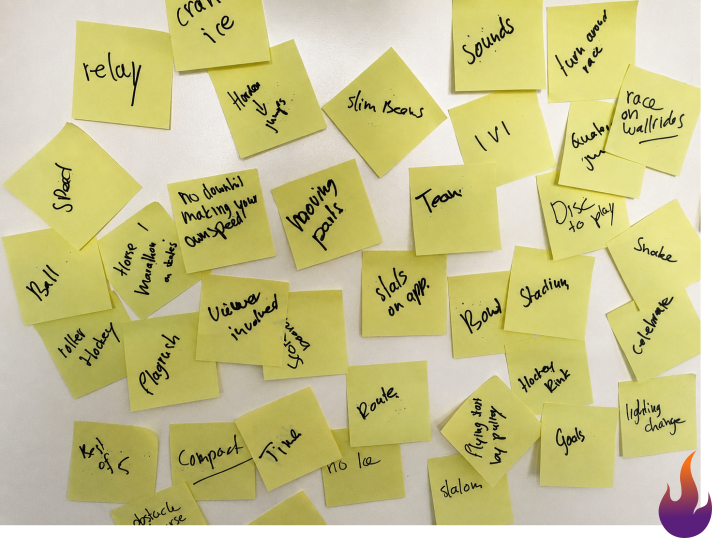
At this stage, I deliberately avoided judging whether an idea was sensible or achievable. The objective was simply to generate possibilities. One easy starting point was to take an existing sport and imagine its players on roller skates. That produced ideas quickly, but it also led to questions about what would make roller skates essential to the sport rather than a visual novelty.
From there, I started thinking about playing surfaces, goals, scoring systems, team sizes, obstacles, technology and atmosphere. Soon, the door near my dining table was covered with sticky notes.
Creating some structure
Once I had generated a broad collection of ideas, I grouped the notes into six categories: sport ideas, team and player composition, playing field, objectives and scoring, atmosphere, and technology.
Organizing the notes revealed a problem with my original question. “A new roller-skating sport people would want to watch” was still too broad. Before selecting ideas, I needed to think more carefully about the kind of viewing experience I wanted to create and who might be interested in it.
I chose three possible audiences to guide the next stage of the experiment: esports viewers, younger people who do not normally follow traditional sports, and people already interested in action and extreme sports. This was not based on audience research. It was an early hypothesis that these groups might be open to a less traditional sport drawing inspiration from arcade games, esports and action-sport events.
From loose ideas to one direction
I was particularly interested in qualities such as clear objectives, fast action, strong visual presentation, immediate feedback and a visible sense of progression. With those qualities in mind, I returned to the sticky notes. I looked for elements that could give the sport a dynamic, gaming-inspired or arcade-like character.
A simple scoring system could make the game easy to understand. Lighting could provide immediate feedback after a goal or during the final minutes of a round. A small team format could keep every player involved in both attacking and defending. Rebound boards and obstacles could make the playing environment an active part of the game.
I then returned to the different sport ideas and selected the direction that seemed to combine a small-team format with obstacles and an interactive playing environment most coherently. The concept gradually became a 3v3 roller-skating sport in which players use their skates to control a specially designed disc. The disc can rebound from the perimeter boards and circular obstacles placed around the court, creating additional angles and tactical possibilities.
The roller skates would therefore not simply change the appearance of an existing sport. They would become part of how the game is played.
Letting go of the bowl
Some ideas were difficult to leave behind, especially my original plan to shape the court like a bowl. Inspired by roller-skating tricks and movements, I imagined its curved walls supporting tricks and altering the trajectory of the disc.
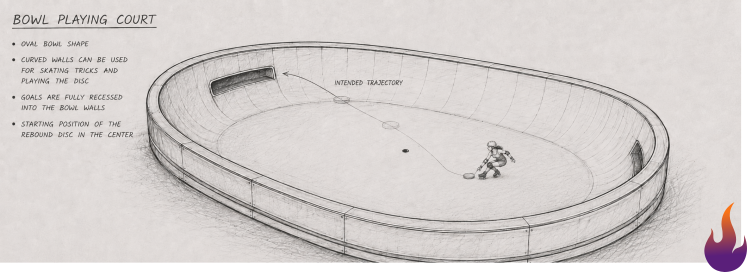
The bowl, however, created practical and viewing challenges. Its shape would restrict filming angles, while its construction could make the sport more expensive and difficult to set up. Although I liked the idea, I chose to abandon it. I kept the principle that made the bowl interesting: the playing environment should influence the movement of the disc. That principle survived through the perimeter boards and circular obstacles.
It was a useful reminder that developing a concept requires not only finding strong ideas but also recognizing when they no longer fit.
As rebounds became central to the gameplay, the concept also found its name:
Roller Rebound
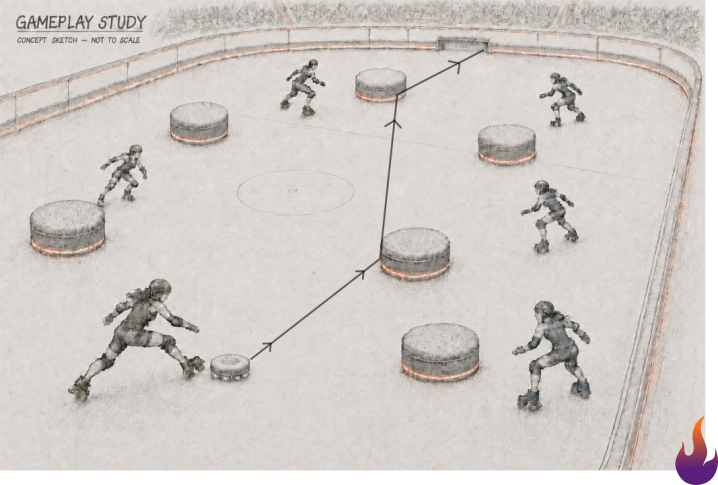
Roller Rebound is an early-stage concept for a 3v3 roller-skating sport built around speed, movement and rebound play. Its visual feedback and arena presentation draw inspiration from gaming and arcade experiences.
The concept combines several elements from the brainstorming process:
• a small-team format without a dedicated goalkeeper
• a specially designed disc controlled using roller skates
• perimeter boards and circular obstacles that redirect the disc
• easy-to-understand, goal-based scoring
• lighting effects that communicate goals, time and urgency
The result is not a validated proposal for a new professional sport. It is one of my first deliberate attempts to use creative-thinking techniques to turn an everyday observation into a more developed and coherent concept.
What remains uncertain
Many important questions are still open. Could players control the Rebound Disc safely and consistently with their skates? Would obstacles create interesting tactics or mainly increase the risk of collisions? Would the proposed audience find the sport appealing? And many more.
If I continued developing Roller Rebound, the first I would explore is whether the basic gameplay, rebounds and obstacle placement could produce an understandable and engaging flow.
What I learned
This experiment allowed me to practice some of the basic principles of brainstorming including postponing judgment, generating a broad range of ideas and organizing them before selecting a direction. Deciding which ideas belonged together, identifying an intended experience and letting go of elements that no longer supported it required more deliberate thought.
Roller Rebound is still speculative, but it gave me a practical way to explore the transition from spontaneous association to deliberate concept development.
Explore the complete Roller Rebound concept in the Idea Vault →