
Glasses Complaint Analysis Tool
Translating the customer’s experience into a structured assessment
A customer who is unhappy with a new pair of glasses can feel challenging, especially for a less experienced eye care professional. We learn the technical knowledge needed to investigate these complaints, but we don’t always have a clear structure for applying that knowledge in practice.
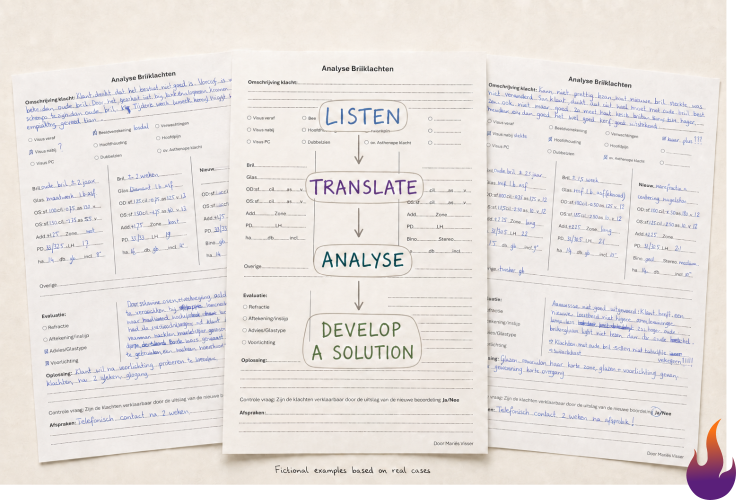
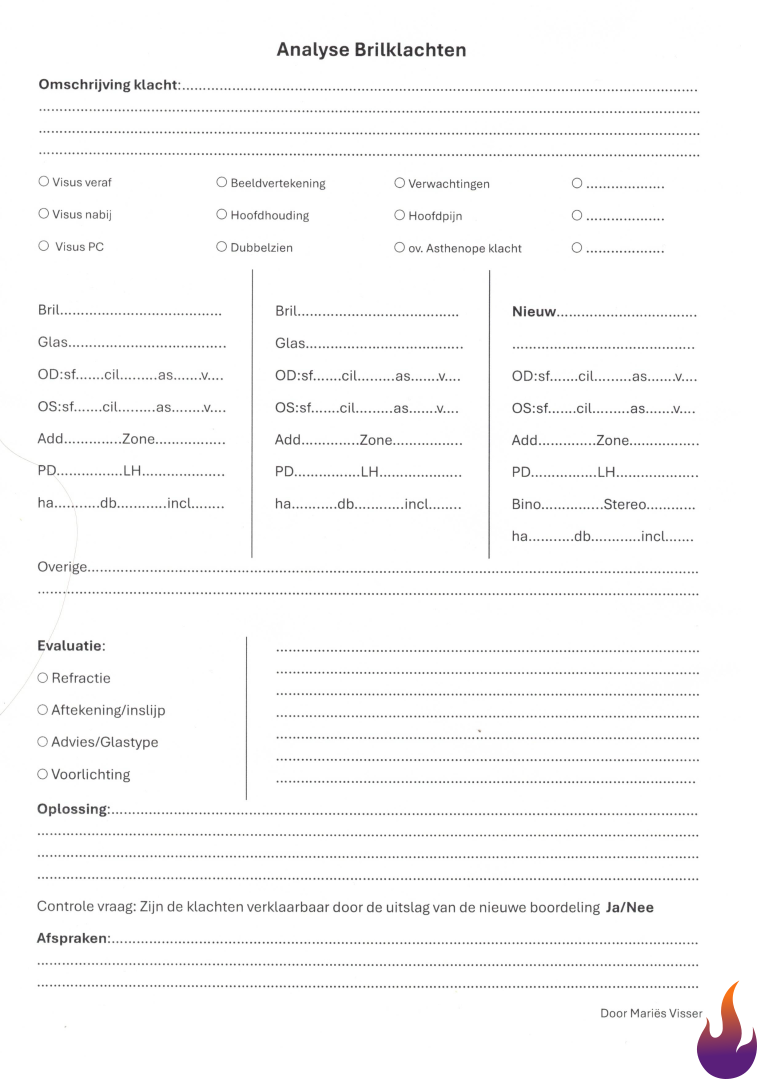
When I was still developing my own analytical skills, I created the Glasses Complaint Analysis Tool: a form that helps structure the conversation, assessment and reasoning behind a spectacle complaint.
Listening before analyzing
The first part of the form is designed to help the eye care professional listen. Open questions give the customer space to describe what they experience in their own words. Those words are important: the customer is telling us something about the problem, but not necessarily in technical language.
It is the task of the specialist to translate that story into the aspect of the glasses that may need further investigation. The form therefore records the customer’s description first and then reduces it to the core of the complaint. Is it related to distance or near vision, distortion, head position, double vision, headaches or something else?
This creates a bridge between the customer’s experience and the technical assessment.
From complaint to possible solution
The tool guides the eye care professional through six steps:
Record the complaint in the customer’s own words.
Identify the main type of visual complaint.
Collect and compare information about the previous glasses, the new glasses, refraction, measurements and fitting.
Assess whether the likely cause relates to the refraction, measurements or fitting, lens recommendation.
Consider possible solutions and check whether they explain the original complaint.
Record the agreements made with the customer.
The completed form creates one overview of the complaint, relevant measurements, professional assessment and proposed solution. It does not replace professional judgment, it supports the specialist in applying that judgment more systematically.
What the tool represents
I originally developed the form as a personal learning aid and used it to become more objective and deliberate when assessing complaints. Years later, I shared it on LinkedIn because I thought it could also help less experienced peers build confidence in their own reasoning.
Looking back, the tool reflects a pattern that still shapes how I work: when information feels complex, I try to make the underlying reasoning visible and give it a practical structure.
Curious how the concept was developed? Read the creative process behind the Tool →