
Looking back at how I tried to create structure in my work
I recently started learning about creative-thinking techniques. This made me look again at two tools I had developed earlier in my career: one for analyzing complaints about new glasses and another for assessing scleral lens fitting cases.
I did not create them as innovation projects. They were personal work aids, made in response to situations in which I found it difficult to keep all the relevant information together.
Learning to listen
I developed the Eyeglasses Complaint Analysis Tool while I was still building my experience as an optician.
Customers who are unhappy with new spectacles describe what they notice in everyday language. They might say that text looks distorted, that the reading area feels too small or that they need to change their head position to see clearly. They do not usually know which technical aspect of the glasses may be involved.
The first part of the form therefore focuses on listening. Open questions give the customer space to explain the complaint in their own words. I then try to bring that story back to its core and translate it into the technical areas that require further investigation.
The form brings together the customer’s description, the old and new glasses, a new assessment, possible causes, a proposed solution and the agreements made. It helped me approach complaints more systematically while developing my own analytical skills.
Years later, I shared it on LinkedIn because I thought it might also be useful to less experienced colleagues.
Making a complex fitting easier to review
I developed the Scleral Lens Fitting Analysis Tool much later, in a more specialized area of my work.
A support request can include observations, photographs, OCT images, fitting characteristics, lens parameters and possible adjustments. These individual elements need to be considered together before an appropriate recommendation can be developed.
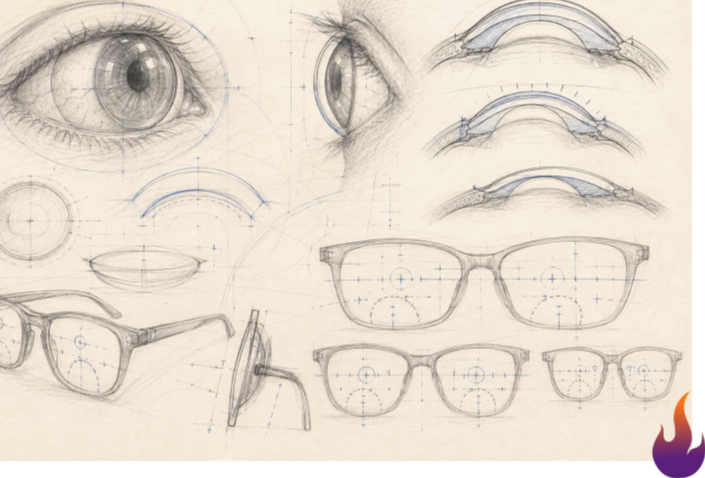
I started making rough drawings to record where particular fitting characteristics appeared. These sketches gradually developed into a printable form that helps me organize observations and document my reasoning in one visual overview.
The form does not perform the assessment or determine the recommendation. It simply supports me in reviewing the available information.
A recurring practical need
The tools address different subjects, but both grew from a similar need: I wanted to make complex information easier to oversee.
In both cases, I tried to:
collect the relevant information
reduce it to its essential elements
translate practical observations into technical considerations
place those elements in a structure that supports my assessment
At the time, I was not consciously applying a creative-thinking method. I was trying to make my work clearer for myself.
Learning about creative-thinking techniques has helped me recognize some familiar elements in that process, such as defining a problem, organizing information and making reasoning visible. It has also shown me what I could do differently.
For me, these examples are not proof of a formal design process. They are simply two moments in my work when putting information on paper helped me think more clearly.
Explore the Glasses Complaint Analysis Tool in the Project Lab →
Explore the Scleral Lens Fitting Analysis Tool in the Project Lab →