
Scleral Lens Fitting Analysis Tool
Turning complex information into a visual overview
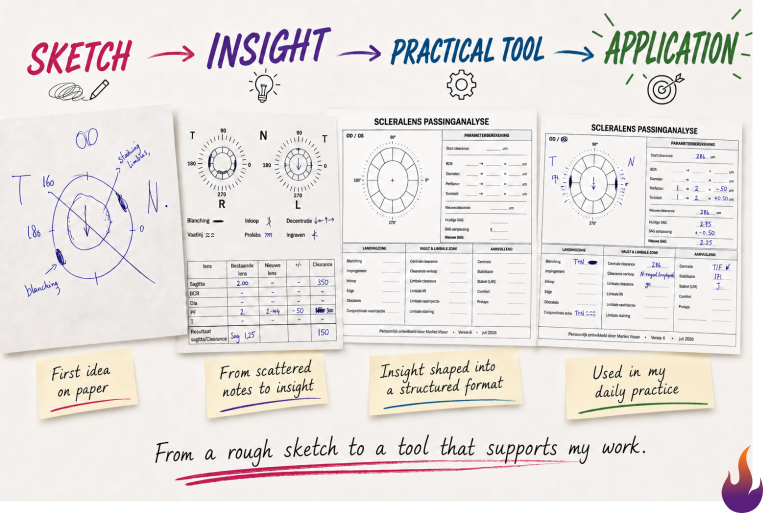
The Scleral Lens Fitting Analysis Tool is a personal working aid that I developed to support my assessment of scleral lens fitting cases.
In my role as a contact lens specialist in the Professional Support department of a specialty contact lens manufacturer, I assess support requests that bring together many different sources of information. These may include observations from the contact lens specialist, photographs, OCT images, fitting characteristics, lens parameters and possible adjustments.
To formulate a recommendation, I need to move beyond the individual findings and bring them together into one coherent picture. When information becomes complex, my instinct is to make it visual and give it structure. What began as a rough sketch gradually evolved into a printable tool that helps me organize observations, consider relationships and document my reasoning.
The challenge
When I started assessing scleral lens fittings and answering support questions, I needed to consider several questions:
What is the scleral lens specialist experiencing?
Can I recognize this in the photographs or OCT images?
What else do I notice?
Which adjustment might correspond with those findings?
How could that adjustment affect other lens parameters?
The challenge was not simply collecting information. I needed to understand how the observations, lens fit and possible parameter changes related to one another.
From sketch to working tool
I began by drawing the lens and eye on paper and writing observations around the sketch. This gave me a place to connect what I saw with what I was considering.
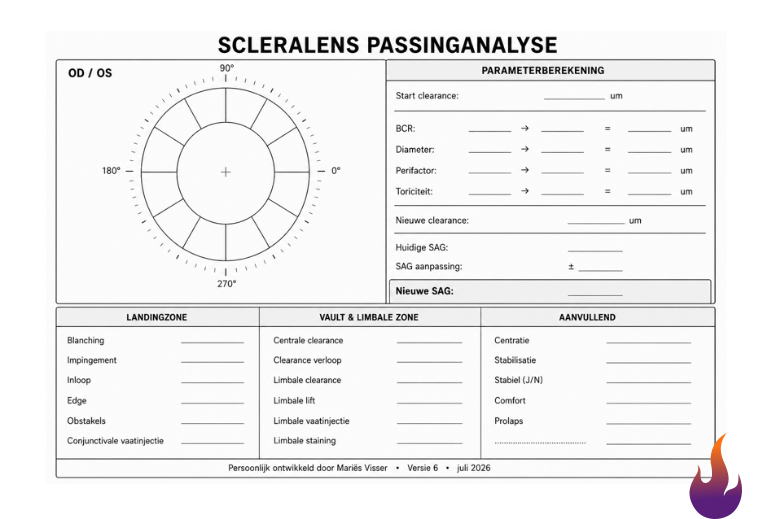
I translated that first sketch into a Word document that I could print, draw on and use for notes. The format developed to include areas for:
visualizing the orientation and lens fit
recording observations about the landing, vault and limbal zones
comparing existing and proposed lens parameters
calculating parameter and clearance changes
considering the possible effects of an adjustment
The tool does not determine the clinical advice. It provides a consistent structure for organizing the available information and identifying what requires further consideration.
Six versions and hundreds of cases
As I used the tool, I encountered situations where the format was not clear enough. New observations led to new fields, while greater understanding changed how I grouped the information. After hundreds of cases the tool has reached version 6, each reflecting something I learned through practice. The document became more detailed, but also more focused. Elements were added when experience showed that they could help me visualize or analyze part of a case more clearly.
Applied to my work
The tool helps me:
bring different sources of information into one overview
work through cases in a more consistent way
visualize the location of observations
connect fitting characteristics with possible parameter changes
review my own reasoning
identify information that still requires attention
It also became a record of my professional development. The form itself did not make me more knowledgeable, but each new version made my growing knowledge and way of thinking more visible and usable.
What I learned
This project began before I started studying creative-thinking and design-thinking methods more deliberately. Looking back, I recognize several approaches I was already using intuitively:
making an abstract problem visual
breaking complex information into related components
starting with a simple version
learning through repeated use
adapting the tool as my knowledge and needs changed
Status
The Scleral Lens Fitting Analysis Tool is currently at version 6 and remains a personal working aid. It is not an automated decision tool, clinical protocol or validated clinical instrument. It supports my personal way of working and does not replace professional knowledge, clinical judgement or consultation with experienced colleagues.
Disclaimer:
This analysis form is a personal initiative developed from my own professional experience. It is not an official CooperVision document and has not been reviewed, validated, approved or endorsed by CooperVision or any other organization.
Curious how the concept was developed? Read about the creative process behind the Tool →